Next Open House: Saturday, Oct 24, 1pm – 4pm RSVP today

Preview This Item
Table of Contents
Introduction 1
Back to Basics 6
What Children Don’t Learn at SVS 17
How and What Do Children Learn at SVS? 21
What do Students Choose? 38
A New Look at Learning 41
On the Nature of Sports at SVS and the Limitations of Language in Describing SVS to the World 62
Reverence for all Life 69
Learning to Trust Oneself 72
The Little Girl Who Taught Me a Big Lesson 78
The Art of Doing Nothing 81
Wrong Questions, Wrong Answers 87
Do People Learn From Courses? 90
A Moment of Insight 100
When does a Person Make Good Use of His Time? 103
Doing “Nothing” at School: A Lesson from History 113
Snapshots 119
Sudbury Valley’s Secret Weapon: Allowing People of Different Ages to Mix Freely at School 121
The Beech Tree 137
How the School is Governed; Who Cares? 140
When You Think of the School Meeting, What Passes Through Your Mind? 146
Five Myths about Democracy 149
Subtleties of a Democratic School 158
The Silent Factor 178
Teaching Justice through Experience 182
SVS Glimpses 186
On Law and Order 190
“When You Were Young”: A True Story 203
To Thyself Be True 206
A School for Today 209
Sample Chapter
From The Sudbury Valley School Experience
Edited by Mimsy Sadofsky and Daniel Greenberg
The Art of Doing Nothing
By Hanna Greenberg
“Where do you work?”
“At Sudbury Valley School.”
“What do you do?”
“Nothing.”
Doing nothing at Sudbury Valley requires a great deal of energy and discipline, and many years of experience. I get better at it every year, and it amuses me to see how I and others struggle with the inner conflict that arises in us inevitably. The conflict is between wanting to do things for people, to impart your knowledge and to pass on your hard earned wisdom, and the realization that the children have to do their learning under their own steam and at their own pace. Their use of us is dictated by their wishes, not ours. We have to be there when asked, not when we decide we should be.
Teaching, inspiring, and giving advice are all natural activities that adults of all cultures and places seem to engage in around children. Without these activities, each generation would have to invent everything anew, from the wheel to the ten commandments, metal working to farming. Man passes knowledge to the young from generation to generation, at home, in the community, at the workplace and supposedly at school. Unfortunately, the more today’s schools endeavor to give individual students guidance, the more they harm the children. This statement requires explanation, since it seems to contradict what I have just said, namely, that adults always help children learn how to enter the world and become useful in it. What I have learned, very slowly and painfully over the years, is that children make vital decisions for themselves in ways that no adults could have anticipated or even imagined.
Consider the simple fact that at SVS, many students have decided to tackle algebra not because they need to know it, or even find it interesting, but because it is hard for them, it’s boring, and they are bad at it. They need to overcome their fear, their feeling of inadequacy, their lack of discipline. Time and again, students who have made this decision achieve their stated goal and take a huge step in building their egos, their confidence, and their character. So why does this not happen when all children are required or encouraged to take algebra in high school? The answer is simple. To overcome a psychological hurdle one has to be ready to make a personal commitment. Such a state of mind is reached only after intense contemplation and self analysis, and cannot be prescribed by others, nor can it be created for a group. In every case it is an individual struggle, and when it succeeds it is an individual triumph. Teachers can only help when asked, and their contribution to the process is slight compared to the work that the student does.
The case of algebra is easy to grasp but not quite as revealing as two examples that came to light at recent thesis defenses. One person to whom I have been very close, and whom I could easily have deluded myself into thinking that I had “guided” truly shocked me when, contrary to my “wisdom,” she found it more useful to use her time at school to concentrate on socializing and organizing dances than to hone the writing skills that she would need for her chosen career as a journalist. It would not have occurred to any of the adults involved with this particular student’s education to advise or suggest the course of action that she wisely charted for herself, guided only by inner knowledge and instinct. She had problems which first she realized and then she proceeded to solve in creative and personal ways. By dealing with people directly rather than observing them from the sidelines, she learned more about them and consequently achieved greater depth and insights, which in turn led to improved writing. Would writing exercises in English class have achieved that better for her? I doubt it.
Or what about the person who loved to read, and lost that love after a while at SVS? For a long time she felt that she had lost her ambition, her intellect, and her love of learning because all she did was play outdoors. After many years she realized that she had buried herself in books as an escape from facing the outside world. Only after she was able to overcome her social problems, and only after she learned to enjoy the outdoors and physical activities, did she return to her beloved books. Now they are not an escape, but a window to knowledge and new experience. Would I or any other teacher have known how to guide her as wisely as she had guided herself? I don’t think so.
As I was writing this another example from many years ago came to mind. It illustrates how the usual sort of positive encouragement and enrichment can be counterproductive and highly limiting. The student in question was obviously intelligent, diligent and studious. Early on, any test would have shown he had a marked talent in mathematics. What he actually did for most of his ten years at SVS was play sports, read literature, and later in his teens, play classical music on the piano. He studied algebra mostly on his own but seemed to have devoted only a little of his time to mathematics. Now, at the age of twenty-four, he is a graduate student in abstract mathematics and doing extremely well at one of the finest universities. I shudder to think what would have happened to him had we “helped” him during his years here to accumulate more knowledge of math, at the expense of the activities he chose to prefer. Would he have had the inner strength, as a little boy, to withstand our praise and flattery and stick to his guns and read books, fool around with sports, and play music? Or would he have opted for being an “excellent student” in math and science and grown up with his quest for knowledge in other fields unfulfilled? Or would he have tried to do it all? And at what cost?
As a counterpoint to the previous example I would like to cite another case which illustrates yet another aspect of our approach. A few years ago a teenage girl who had been a student at SVS since she was five told me quite angrily that she had wasted two years and learned nothing. I did not agree with her assessment of herself, but I did not feel like arguing with her, so I just said, “If you learned how bad it is to waste time, why then you could not have learned a better lesson so early in life, a lesson that will be of value for the rest of your days.” That reply calmed her, and I believe it is a good illustration of the value of allowing young people to make mistakes and learn from them, rather than directing their lives in an effort to avoid mistakes.
Why not let each person make their own decisions about their use of their own time? This would increase the likelihood of people growing up fulfilling their own unique educational needs without being confused by us adults who could never know enough or be wise enough to advise them properly.
So I am teaching myself to do nothing, and the more I am able to do it, the better is my work. Please don’t draw the conclusion that the staff is superfluous. You might say to yourself that the children almost run the school themselves, so why have so many staff, just to sit around and do nothing. The truth is that the school and the students need us. We are there to watch and nurture the school as an institution and the students as individuals.
The process of self direction, or blazing your own way, indeed of living your life rather than passing your time, is natural but not self evident to children growing up in our civilization. To reach that state of mind they need an environment that is like a family, on a larger scale than the nuclear family, but nonetheless supportive and safe. The staff, by being attentive and caring and at the same time not directive and coercive, gives the children the courage and the impetus to listen to their own inner selves. They know that we are competent as any adult to guide them, but our refusal to do so is a pedagogical tool actively used to teach them to listen only to themselves and not to others who, at best, know only half the facts about them.
Our abstaining from telling students what to do is not perceived by them as a lack of something, an emptiness. Rather it is the impetus for them to forge their own way not under our guidance but under our caring and supportive concern. For it takes work and courage to do what they do for and by themselves. It cannot be done in a vacuum of isolation, but thrives in a vital and complex community which the staff stabilizes and perpetuates.
From The Sudbury Valley School Experience
Edited by Mimsy Sadofsky and Daniel Greenberg
Back to Basics
By Daniel Greenberg
Why go to school?
For people who like to think through the important questions in life for themselves, Sudbury Valley stands as a challenge to the accepted answers.
Intellectual basics
The first phrase that pops into everyone’s mind is: “We go to school to learn.” That’s the intellectual goal. It comes before all the others. So much so, that “getting an education” has come to mean “learning” — a bit narrow, to be sure, but it gets the priorities clear.
Then why don’t people learn more in schools today? Why all the complaints? Why the seemingly limitless expenditures just to tread water, let alone to progress?
The answer is embarrassingly simple. Schools today are institutions in which “learning” is taken to mean “being taught.” You want people to learn? Teach them! You want them to learn more? Teach them more! And more! Work them harder. Drill them longer.
But learning is a process you do, not a process that is done to you! That is true of everyone. It’s basic.
What makes people learn? Funny anyone should ask. Over two thousand years ago, Aristotle started his most important book with the universally accepted answer: “Human beings are naturally curious.” Descartes put it slightly differently, also at the beginning of his major work: “I think, therefore I am.” Learning, thinking, actively using your mind — it’s the essence of being human. It’s natural.
More so even than the great drives — hunger, thirst, sex. When you’re engrossed in something — the key word is “engrossed” — you forget about all the other drives until they overwhelm you. Even rats do that, as was shown a long time ago.
Who would think of forcing people to eat, or drink, or have sex? (Of course, I’m not talking about people who have a specific disability that affects their drives; nor is anything I am writing here about education meant to apply to people who have specific mental impairments, which may need to be dealt with in special, clinical ways.) No one sticks people’s faces in bowls of food, every hour on the hour, to be sure they’ll eat; no one closets people with mates, eight periods a day, to make sure they’ll couple.
Does that sound ridiculous? How much more ridiculous is it, then, to try to force people to do that which above all else comes most naturally to them! And everyone knows just how widespread this overpowering curiosity is. All books on child rearing go to great lengths to instruct parents on how to keep their little children out of things — especially once they are mobile. We don’t stand around pushing our one year olds to explore. On the contrary, we tear our hair out as they tear our house apart, we seek ways to harness them, imprison them in play pens. And the older they get, the more “mischief” they get into. Did you ever deal with a ten year old? A teenager?
People go to school to learn. To learn, they must be left alone and given time. When they need help, it should be given, if we want the learning to proceed at its own natural pace. But make no mistake: if a person is determined to learn, they will overcome every obstacle and learn in spite of everything. So you don’t have to help; help just makes the process a little quicker. Overcoming obstacles is one of the main activities of learning. It does no harm to leave a few.
But if you bother the e person, if you insist the person stop his or her own natural learning and do instead what you want, between 9:00 AM and 9:50, and between 10:00 AM and 10:50 and so forth, not only won’t the person learn what s/he has a passion to learn, but s/he will also hate you, hate what you are forcing upon them, and lose all taste for learning, at least temporarily.
Every time you think of a class in one of those schools out there, just imagine the teacher was forcing spinach and milk and carrots and sprouts (all those good things) down each student’s throat with a giant ramrod.
Sudbury Valley leaves its students be. Period. No maybes. No exceptions. We help if we can when we are asked. We never get in the way. People come here primarily to learn. And that’s what they all do, every day, all day.
Vocational basics
The nitty-gritty of going to school always comes up next, after “learning.” When it comes right down to it, most people don’t really give a damn what or how much they or their children learn at school, as long as they are able to have a successful career — to get a good job. That means money, status, advancement. The better the job you get, the better was the school you went to.
That’s why Phillips Andover, or Harvard, rank so highly. Harvard grads start out way up the ladder in every profession. They are grateful, and when they grow up, they perpetuate this by bestowing the best they have to offer on the new Harvard grads they hire; and by giving big donations to Harvard. So it goes for Yale, Dartmouth and all the others.
So what kind of a school is most likely today, at the end of the twentieth century, to prepare a student best for a good career?
We don’t really have to struggle with the answer. Everyone is writing about it. This is the post industrial age. The age of information. The age of services. The age of imagination, creativity, and entrepreneurialism. The future belongs to people who can stretch their minds to handle, mold, shape, organize, play with new material, old material, new ideas, old ideas, new facts, old facts.
These kind of activities don’t take place in the average school even on an extra-curricular basis. Let alone all day.
At Sudbury Valley, these activities are, in a sense, the whole curriculum.
Does it sound far-fetched? Perhaps to an untrained ear. But history and experience are on our side. How else to explain that fact that all our graduates, barring none, who wish to go on to college and graduate school, always get in, usually to the schools of first choice? With no transcripts, no records, no reports, no oral or written school recommendations. What do college admissions officers see in these students? Why do they accept them — often, grab them? Why do these trained administrators, wallowing in ‘A’ averages, glowing letters from teachers, high SAT scores — why do they take Sudbury Valley grads?
Of course you know the answer, even if it is hard to admit; it runs so against the grain. These trained professionals saw in our students bright, alert, confident, creative spirits. The dream of every advanced school.
The record speaks for itself. Our students are in a huge array of professions (or schools, in the case of more recent graduates) and vocations. They are doctors, dancers, musicians, businessmen, artists, scientists, writers, auto mechanics, carpenters . . . No need to go on. You can meet them if you wish.
If a person came to me today and said, simply: “To what school should I send my child if I want to be assured that she will get the best opportunity for career advancement in the field of her choice?” I would answer without the least hesitation, “The best in the country for that purpose is Sudbury Valley.” Alas, at present it is the only type of school in the country that does the job, with an eye to the future.
As far as vocations are concerned, Sudbury Valley has encountered Future Shock head on and overcome it. No longer is there any need to be mired in the past.
Moral basics
Now we come to a touchy subject. Schools should produce good people. That’s as broad a platitude as — mother and apple pie. Obviously, we don’t want schools to produce bad people.
How to produce good people? There’s the rub. I dare say no one really knows the answer, at least from what I see around me. But at least we know something about the subject. We know, and have (once again) known from ancient times, the absolutely essential ingredient for moral action; the ingredient without which action is at best amoral, at worst, immoral.
The ingredient is personal responsibility.
All ethical behavior presupposes it. To be ethical you must be capable of choosing a path and accepting full responsibility for the choice, and for the consequences. You cannot claim to be a passive instrument of fate, of God, of other men, of force majeure; such a claim instantly renders all distinctions between good and evil pointless and empty. The clay that has been fashioned into the most beautiful pot in the world can lay no claim to virtue.
Ethics begins from the proposition that a human being is responsible for his or her acts. This is a given. Schools cannot change this, or diminish it. Schools can, however, either acknowledge it or deny it.
Unfortunately, virtually all schools today choose in fact to deny that students are personally responsible for their acts, even while the leaders of these schools pay lip service to the concept. The denial is threefold: schools do not permit students to choose their course of action fully; they do not permit students to embark on the course, once chosen; and they do not permit students to suffer the consequences of the course, once taken. Freedom of choice, freedom of action, freedom to bear the results of action — these are the three great freedoms that constitute personal responsibility.
It is no news that schools restrict, as a matter of fundamental policy, the freedoms of choice and action. But does it surprise you that schools restrict freedom to bear the consequences of one’s actions? It shouldn’t. It has become a tenet of modern education that the psyche of a student suffers harm to the extent that it is buffeted by the twin evils of adversity and failure. “Success breeds success” is the password today; encouragement, letting a person down easy, avoiding disappointing setbacks, the list goes on.
Small wonder that our schools are not noted for their ethical training. They excuse their failure by saying that moral education belongs in the home. To be sure, it does. But does that exclude it from school?
Back to basics. At Sudbury Valley, the three freedoms flourish. The buck stops with each person. Responsibility is universal, ever present, real. If you have any doubts, come and look at the school. Watch the students in action. Study the judicial system. Attend a graduation, where a student must convince an assemblage of peers that s/he is ready to be responsible for himself or herself in the community at large, just as the person has been at school.
Does Sudbury Valley produce good people? I think it does. And bad people too. But the good and the bad have exercised personal responsibility for their actions at all times, and they realize that they are fully accountable for their deeds. That’s what sets Sudbury Valley apart.
Social basics
Some time ago it became fashionable to ask our schools to look after the social acclimatization of students. Teach them to get along. Rid our society of social misfits by nipping the problem in the bud, at school. Ambitious? Perhaps. But oh, how many people have struggled with reports from school about their own — or their child’s — social adaptations, or lack of them! Strange, isn’t it, how badly people sometimes screw up what they do? I mean, trying to socialize people is hard enough; but the schools seem almost methodically to have created ways of defeating this goal.
Take age segregation, for starters. What genius looked around and got the idea that it was meaningful to divide people sharply by age? Does such division take place naturally anywhere? In industry, do all twenty-one year old laborers work separately from twenty years olds or twenty-three year olds? In business, are there separate rooms for thirty year old executives and thirty-one year old executives? Do two year olds stay apart from one year olds and three year olds in the playgrounds? Where, where on earth was this idea conceived? Is anything more socially damaging than segregating children by year for fourteen — often eighteen — years.
Or take frequent segregation by sex, even in coed schools, for varieties of activities.
Or the vast chasm between children and adults — have you ever observed how universal it is for children not to look adults in the eye?
And now let’s peek into the social situation created for children within their own age group. If the schools make it almost impossible for a twelve year old to relate in a normal human fashion to eleven year olds, thirteen year olds, adults, etc., what about other twelve year olds?
No such luck. The primary, almost exclusive mode of relationship fostered by schools among children in the same class is — competition! Cut-throat competition. The pecking order is the all-in-all. Who is better than whom, who smarter, faster, taller, handsomer — and, of course, who is worse, stupider, slower, shorter, uglier.
If ever a system was designed effectively to produce competitive, obnoxious, insecure, paranoid, social misfits, the prevailing schools have managed it.
Back to basics
In the real world, the most important social attribute for a stable, healthy society is cooperation. In the real world, the most important form of competition is against oneself, against goals set for and by a person for that person’s own achievement. In the real world, interpersonal competition for its own sake is widely recognized as pointless and destructive — yes, even in large corporations and in sports.
In the real world, and in Sudbury Valley, which is a school for the real world.
Political basics
We take it for granted that schools should foster good citizenship. Universal education in this country in particular always kept one eye sharply focused on the goal of making good Americans out of us all.
We all know what America stands for. The guiding principles were clearly laid down by our founding fathers, and steadily elaborated ever since.
This country is a democratic republic. No king, no royalty, no nobility, no inherent hierarchy, no dictator. A government of the people, by the people, for the people. In matters political, majority rule. No taxation without representation.
This country is a nation of laws. No arbitrary authority, no capricious government now giving, now taking. Due process.
This country is a people with rights. Inherent rights. Rights so dear to us that our forefathers refused to ratify the constitution without a Bill of Rights added in writing, immediately.
Knowing all this, we would expect — nay, insist (one would think) — that the schools, in training their students to contribute productively to the political stability and growth of America, would
- be democratic and non-autocratic;
- be governed by clear rules and due process;
- be guardians of individual rights of students.
A student growing up in schools having these features would be ready to move right into society at large.
But the schools, in fact, are distinguished by the total absence of each of the three cardinal American values listed.
They are autocratic — all of them, even “progressive” schools.
They are lacking in clear guidelines and totally innocent of due process as it applies to alleged disrupters.
They do not recognize the rights of minors.
All except Sudbury Valley, which was founded on these three principles.
I think it is safe to say that the individual liberties so cherished by our ancestors and by each succeeding generation will never be really secure until our youth, throughout the crucial formative years of their minds and spirits, are nurtured in a school environment that embodies these basic American truths.
Back to basics
So you see, Sudbury Valley was started in 1968 by people who thought very hard about schools, about what schools should be and should do, about what education is all about in America today.
We went back to basics. And we stayed there. And we jealously guarded these basics against any attempts to compromise them. As we and our successors shall surely continue to stand guard.
Intellectual creativity, professional excellence, personal responsibility, social toleration, political liberty — all these are the finest creations of the human spirit. They are delicate blossoms that require constant care.
All of us who are associated with Sudbury Valley are proud to contribute to this care.
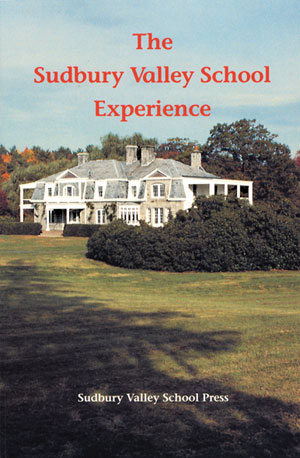
The Sudbury Valley School Experience
Edited by Mimsy Sadofsky and Daniel Greenberg; with photographs by Michael Greenberg, Andrew Brilliant and Carol Palmer
234 pages
3rd ed., 1992
Also Available:
How do Sudbury Schools work? Many excellent articles on the concepts and experiences that make up a Sudbury School have been collected in two books, this one and Reflections on the Sudbury School Concept, which together provide a solid introduction to this model of education.
“The people who play sports as we do at S.V.S. learn far more profound lessons about life than those that can be taught by regimented, performance-oriented sports. They learn teamwork – not the ‘we against them’ type of teamwork, but the teamwork of a diverse group of people of diverse talents organizing themselves to pursue a common activity – the teamwork of life. They learn excellence, not the ‘I’m a star’ type of excellence, but the type of excellence that comes from setting a standard for yourself to live up to and then trying your best to live up to it.
“I’m twenty-three years old and I’ve played a lot of soccer. It would be pretty silly for me to try to be better than the three eight-year-olds who crowd around my feet every time I try to kick the ball. I think that the eight year olds are too busy running after kids who are three feet taller than they are to worry about being the best eight year old. In this game, as in real life, the only standard that matters is one you set for yourself. One of the profound truths you learn is that we are all so different from each other that peer pressure and comparisons of worth are meaningless. If you’re eleven years old and you are only allowed to play with other eleven year olds, it’s very hard to glimpse this profound truth which unlocks the true meaning of excellence.”
Is Sudbury Valley Right For You?
Have more questions? Interested in visiting the campus? We’d love to hear from you.