Next Open House: Saturday, Oct 24, 1pm – 4pm RSVP today

Home > Resources > Bookstore > Outline of a New Philosophy
0

No products in the cart.

Preview This Item

Table of Contents

Introduction

Part 1   A Philosophy for the Age of Science
I discover that physics is very imperfect and very old 5
Ancient science comes alive (Anaxagoras, Eleatics, Aristotle, Plato) 9
Seventeenth century science as a mass movement (Bacon and Galileo) 12
Seventeenth century science as fantasy, and the demise of common sense (Copernicus, Kepler, Galileo, Toricelli and atmospheric pressure) 20
The scientific revolution and the nature of science 39
How science corrects itself and progresses — two views 50
Newton’s concept of mass as an example 53
Science and Western culture in the seventeenth century 56
From causal to probabilistic explanations 59
Why the classical analysis of language is a failure 66
A new theory of language 69
Objective, subjective, and shared — some key distinctions 77
Verbal and non-verbal concepts; the discrete vs. the diffuse 80
Degrees of probability, technology, and the chasm between probability and certainty 85
How the Greeks invented science, in the traditional sense of the term 89
How change takes place in science 93
Science, technology, and truth: why science works 98
Additional details: equivalence; instantaneity; numerical probability; religion and philosophy 101
Science education 105

Part 2   The Human Mind
I become dissatisfied with current educational practices 115
How the brain works 119
How the brain directs the organism 121
Teaching and learning 124
Problem solving 129
Motivation 133
Reflexes, drives, and instincts 138
How the organism reacts to being driven to extremes 148
Psychotherapy 154

Part 3   The Development of the Human Race
The theory of evolution, modified for a parallel framework 165
Global interconnectedness and the role of communications in evolution 170
An overview and a warning before undertaking a study of the past 176
Early Man 181
The relations between the size and structure of societies 184
The five stabilizing features of a social order 198
The uniquely stable experience of Jewish history as a special example 207
Modern times 219
Nazi Germany as illustrating the trends of modern Western history 225
The role of education in modern times 229
The democratic ethos — the “sleeper” of modern history — and English culture 232
The evolutionary jump that has transformed current realities and has confronted us with a basic choice 242
Why a small group can wield a large influence 257
Education for a democratic ethos today 261

Part 4   Some Final Notes
Free communication in a democratic society 269
Factors giving an institution stability and form within a culture 278

Appendixes
Appendix 1   Draft of an essay on centralization vs. local autonomy in education; (circa 1966) 303
Appendix 2   First and second drafts of an essay on the values of science; (circa 1964-1965) 309

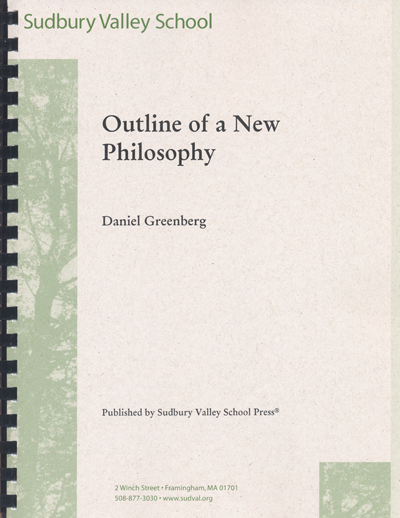
Outline of a New Philosophy

$29.95

Daniel Greenberg
372 pages
2nd ed., 1996

SKU:118

Outline of a New Philosophy delineates the author’s journey towards understanding the modern world. A wide variety of topics are discussed, including the philosophy and history of science, evolution and cultural history.

“Every world-view is the result of a personal odyssey. Current convention dictates that philosophers should eliminate all personal references from their theoretical writings, in an attempt to lend an aura of objectivity to their work. The impersonal style of current philosophical treaties places an unnecessary burden on the reader: the poor reader is hard pressed to figure out where all these ideas came from, and how they are related in the author’s mind. They seem to appear from nowhere, and their relationships are entirely mechanical; whereas in fact they spring from the unique configuration of the author’s mind and they can only be understood by another mind when their context is presented along with them to the fullest possible extent.

“I have therefore departed from convention. In this book, I present my philosophy of nature, history, and life in its personal context, as it relates to my experience. In a sense this is the story of my personal journey towards a school – Sudbury Valley School. In my case, the path to the school involved a complete reshaping of my life, and the creation of a series of intellectual structures radically different from those fashionable among my contemporaries.”

Is Sudbury Valley Right For You?

Have more questions? Interested in visiting the campus? We’d love to hear from you.