Next Open House: Saturday, Oct 24, 1pm – 4pm RSVP today

Preview This Item
Table of Contents
Preface 5
Part I Where We Stand Today
Chapter 1
The Problem 11
Chapter 2
The American Dream 19
Chapter 3
Our Un-American Schools 30
Chapter 4
The Solution: A Strategy for Education in America Today 39
Part II Blueprints
Chapter 5
Law and Order: Foundations of Discipline 49
Chapter 6
What About Learning? 56
Chapter 7
Watching the School Budget Drop from Year to Year 64
Chapter 8
A School without Privilege 71
Part III The Tactics of Change
Chapter 9
Understanding the Past as a Prelude to the Future 77
Chapter 10
The First Step: A Prototype School 82
Chapter 11
The Second Step: Satellite Public Schools — Freedom of Choice 89
Chapter 12
The Final Step: Public Schools with Public Support 92
Part IV The Choices We Face
Chapter 13
Schools Fit for a King or for a Citizen? 99
Chapter 14
Melting-Pot or Multi-Culture? 102
Chapter 15
Federal or Local Control? 105
Chapter 16
Today or Tomorrow? 108
Sample Chapter
From The Crisis in American Education
By The Sudbury Valley School Trustees
The American Dream
There are three root ideas underlying the ethical, political, and social structure of the United States. Each of these three, taken alone, has a long history in other cultures, and occasionally two of them have appeared together. America has been unique, until recently, in combining all three into that particular mix that gives our country its special character.
These three ideas serve as guiding principles for the nation as a whole. They are, in a sense, over-arching ideals towards which we strive. There is no denying that the American people have, at different times of their history, and at different places on their far-flung continent, fallen short of converting these ideas into practical reality; but the ideas nevertheless remain, clear and sharp, as our basic underpinning, and our failures to live by them have always filled us with guilt.
The first of these is the idea of Individual Rights: every person is endowed with certain “inalienable rights,” rights that belong to him as his own, as his inherent possession — not granted as a gift by some benevolent ruler, not given as a privilege by an all-powerful state, but belonging to him, without qualification, as his rights. They cannot be removed, or explained away; nor can they be violated by any person, government, or power, as long as law and order prevail.
It is not essential to agree on the source of these rights. Some people hold that they emanate from God. Other people think that they derive from some natural law governing man. Still others think they are rooted in a science of man and society. There are many philosophical theories about the rights of man — and many people who have no theory whatsoever believe in them intuitively. All agree that sacred individual rights exist, and are essential to our way of life. In fact, we are all aware of how even the ratification of our constitution depended on the subsequent passage of our Bill of Rights as the first ten amendments, where many of the specific rights recognized in this country were spelled out in detail.
It is also not essential to agree on the exact number and nature of these rights. Different people, different communities, and different times have somewhat different lists. For example, the right of privacy is only now gradually coming into its own. By contrast, the right of free speech is high on everyone’s list, and has been from the beginning of our history. Of course, in the day to day progress of our lives, it is important to know exactly what rights are recognized. But for the purposes of understanding the basis of our way of life, all we have to do is realize that a set of individual rights belonging to every person does in fact exist.
Many societies exist today where the concept of Individual Rights does not play any role at all. For example, societies in which the State is held to be the highest good do not recognize any limitations on the power of the State to enter into an individual’s life for the presumed good of the State. Historically speaking, the English have long been known as the champions of the idea of personal rights, and Britishers carried this idea with them to their colonies around the globe — including the thirteen colonies from which the United States was formed.
There has been much unevenness in the unfolding history of individual rights in this country. Specific rights mentioned and protected by the Federal Constitution, and generally agreed upon by the population at large, were not always recognized by state and local courts. Only after passage of the Fourteenth Amendment were Federal rights gradually extended, through the courts, to all jurisdictions, a process still going on today.
More significantly, there have been several changes in the meaning of the word “person,” to whom rights belong. Not until the time of the Civil War, after the elimination of slavery, were African Americans considered “persons” who had all the rights belonging to their former masters. And not until the early part of the twentieth century was the concept of personal rights extended to fully half the adult population — the female half! We often like to forget how recently these extensions of rights have taken place; it is embarrassing to think that when this century dawned on our nation, three-quarters of us were disenfranchised and devoid of rights.
How much more embarrassing to realize that even now, the concept of Individual Rights does not extend to a huge fraction of our population — namely, to children. At varying ages before eighteen, a few rights are dribbled here and there at children, but only at age eighteen are people fully persons before the law.
We still have a way to go before this universally recognized root idea of American civilization is universally applied. But there is no denying that the concept of Individual Rights has always been a cornerstone of our culture, and that its very history of gradual extension has been due to its daily presence in our national consciousness.
The second root idea is Political Democracy: all decisions governing the community are decided by the community in a politically democratic way. The first root idea, of Individual Rights, covers those actions in a person’s life that primarily affect himself, and for which he is individually responsible. The second root idea, of Political Democracy, covers those actions that primarily affect other people, and for which the community is responsible. There is no sharp dividing line; there never are sharp dividing lines in real life. But there are large areas to which each of these ideas applies independently, and these areas are generally agreed upon.
Also, there is no precise definition to the word “community.” The general principle is that the people most affected by the action participate in deciding on it. That is the basis for the separation of powers in this country between local, county, state, and Federal government. Matters affecting one town alone are decided by that town; matters affecting a county are decided by that county; and so on up the line. Again, the lines of authority are never clear, and always subject to debate and court action. One of the great questions of this age has been the extent of the Federal government’s jurisdiction over affairs that were once considered to be purely local. There is no doubt that the existence of a fast, efficient nationwide communications network — telephone, telegraph, radio, television, internet, postal service, and transportation system — has blurred the boundaries that once clearly separated groups of people in the horse-and-buggy days.
Finally, there is no simple meaning to the words “politically democratic decision-making.” Basically, they refer to a process where issues are decided by vote, and not by decree. But there are many variations. Voting can be by secret ballot, by voice, by show of hands, or by other means. Decisions can be by majority, plurality, two-thirds, or other proportion. The voters can be the entire eligible population, as in old — and some present day — New England Town Meetings, or they can be representatives chosen in some way by the population. None of these variations change the essence of the process, however, which is that of a group vote rather than an arbitrary autocratic issuance of orders.
Political Democracy has a distinguished history. We are taught that Athens of ancient Greece was the birthplace of democracy. There were probably many other earlier instances, but Athens is certainly the first case that is well known and well documented today. Many, many other tribes, cities, states, and countries have since been governed democratically. In modern times, the greatest exponent of political democracy was England, which gradually developed forms and concepts of democratic government over a period of centuries. As in the case of Individual Rights, the English took the root concept of Political Democracy with them all over the world, to all their colonies, including the thirteen American colonies from which our country was fashioned.
Although Individual Rights and Political Democracy developed together in England, it is worth remembering that the two are not inseparable, and they often don’t go hand in hand. In fact, democracy without the protection of individual rights is so distasteful to us that we often refer to it in derogatory terms, such as “mob rule.” Athens is a case in point: the majority could decide anything it wanted to, at any time, governing any citizen, and that was that. The same thing happened in the days of the French Revolution, when many a person went to the guillotine at the instant wish of a majority, without being able to exercise even a semblance of the rights that we all possess here today.
By the same token, individual rights exist in societies where democracy has never set foot. Indeed, in England rights were established well before meaningful democratic procedures had been adopted — rights that protected the citizenry from the arbitrary rule of kings and princes.
The root idea of Political Democracy has not always been honored in practice. We have had, and still have, many instances of corrupt government, of boss rule, of privilege and favoritism. But the forms and ideas of democratic government are everywhere, and an aware, sensitive populace has always been able to restore honesty and pure government when it chose to do so.
The third root idea is Equal Opportunity: every person has an equal chance to obtain any goal. There is no privilege in America, a phenomenon stressed even in our written Constitution. People are born equal, and they start out with equal chances in life.
Present-day realities fall far short of realizing this idea, but that should not blind us to the existence of the idea and to the immense role it has always played in our history. The personal histories of many of our presidents and leaders is testimony to this, as is the Horatio Alger phenomenon in our popular literature.
We have always striven for equal opportunity for all people, and some of our greatest internal conflicts have occurred around this theme: the Civil War, the battles fought by successive waves of immigrants, the repeated struggles of minority groups. These conflicts could take place only because the deprived groups could wave the universally recognized banner of Equal Opportunity. The final outcome was always a foregone conclusion: privilege had to yield, because privilege had no basis for survival in this country.
Equal Opportunity does not, of course, mean an equal outcome for everybody. We have insisted on giving everyone the same place in the starting line, and then having them run where and how they wished; we have not insisted on making everyone run together in step.
It might be worth noting that England was not a pioneer of Equal Opportunity, and that has been the key difference between the English experience and the American experience. England gloried in privilege, and the vestiges of privilege can still be found there.
America was, by contrast, a beacon-light of Equal Opportunity to the whole world from its earliest history. Here, people from every country and every walk of life could dream of making a fresh start, with the same odds as everyone else. This dream populated our country through various waves of immigration. Now that unlimited immigration has stopped, the idea of Equal Opportunity remains to govern each person’s fate at birth, at the start of his life-struggle, and at every instance when he chooses to make a move to other places and other pursuits.
Individual Rights, Political Democracy, and Equal Opportunity — these are the three root ideas of the American way of life. Our country has pioneered in their development individually and, especially, together. Take any one of them away, and you are in another country, another tradition, another culture. And we shall stand or fall on our ability to continue to give meaning to all three ideas in our unfolding history.
It is impossible to exaggerate the depth of our commitment to these ideas. We are fanatics about them, and we insist on universal adherence to them. No government or authority could get to first base trying to strip us of our Individual Rights; each and every citizen guards these rights with jealousy and passion. No government or authority could impose itself as a monarchy or dictatorship — indeed, we would not even allow the citizens of a city or state to freely vote that a person should be king or dictator. No government or authority could impose privilege by law, and none can long survive the imposition of privilege by corrupt deed.
These three root ideas are inseparable from each other, and from our country’s fate. They are the American Dream. To the extent that they are practiced, the American Dream becomes the American Reality.
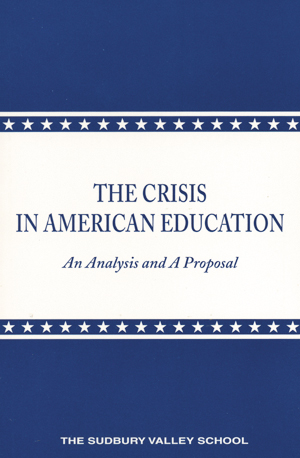
The Crisis in American Education
An Analysis and A Proposal
109 pages
1970
This book quickly became a classic and is still enjoyable and relevant. It lays out the foundations of the Sudbury model in clear, easy terms.
“No one would work to establish a new school if he wasn’t driven to it by extreme dissatisfaction with the schools already available. You simply don’t set out into the jungles of education, administration, bureaucracy, and finance unless you are thoroughly convinced that the present alternatives are incapable of serving your needs.
“The people who established the Sudbury Valley School have not been an exception to this rule. All have been actively seeking a new way in education, and all have made large investments of thought, time, and material to the fledgling school. Their commitment, too, is nothing new in the story of innovation and change.
“But there are several features that distinguish the Sudbury Valley School from all other educational innovations in this country. These features have one over-riding characteristic in common: they are firmly rooted in the traditional values and institutions that constitute our American heritage.”
Is Sudbury Valley Right For You?
Have more questions? Interested in visiting the campus? We’d love to hear from you.