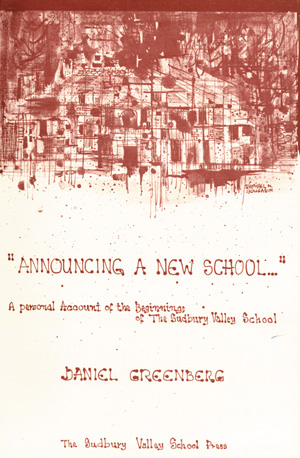
Sample Chapter
From Announcing a New School
By Daniel Greenberg
The Physical Plant
We got a great deal of insight into good campus design accidentally. We went out and looked for a place and found our campus, and it happened to be an old, distinguished estate. We might have ended up with a plot of ground on which we had to build; or we might have ended up with any number of other things. I don’t know what we would have thought then, but probably we would have been thinking along pretty standard lines had we designed a campus from scratch. We would have tried to decide what kind of design would best suit the needs of the school as we envisioned these needs in advance, and we doubtless would have come up with an art center, and information center, and this and that. It’s called campus planning. But as it turned out, none of this came to be, because we had a ready-made building. And we found out something from our experience with this building that, not surprisingly, reflects much of the very early centers of learning in medieval and early modern Europe.
We found out that there was something extraordinarily suitable about an estate-size building, a building planned and built as a large estate, as a design for a school. Let’s put it this way. You can start by pointing to some of the features of a planned campus, in the standard sense of the term, that really are inappropriate to the kind of school we’re talking about. The main feature is that it’s planned in a linear fashion: there’s a planned use for each building, there’s a restricted degree of flexibility. You build a laboratory and that’s what it is. You build a library and that’s what it’s designed to be. There’s a tremendous degree of linearity to the use of the buildings, which reflects the linearity of the institutions they serve and is very much out of character with our school. There isn’t the kind of flexibility, the kind of give, that could respond to change and fluctuation in needs of various student bodies. You program what can be done at other schools so tightly that you lay the groundwork for channeling a student’s possibilities for activity.
The second thing wrong with these buildings is that they’re like jails, they’re cold, they’re mass produced, everything about them smacks of the regimented linearity of the industrial age. Long corridors, big rooms with lots of chairs lined up in them, toilets with urinals lined up next to each other, cafeterias where everybody eats at the same place at a given time, and so forth. They have a character that’s very compatible with modern society. When you look at modern architecture the thing that’s striking about it is the basic similarity between structures; and that’s to be expected because they all share the linearity, the aspiration to linearity and the aspiration to regimentation, that modern society has. So whether you’re looking at a place of entertainment, a shopping center, a prison, a school, a college, a factory – whatever you happen to be looking at, you get the same kind of structure that has become almost synonymous with the word “institutional.” And that’s really what’s wrong with modern campuses.
Another thing that is also not in character with our school is very small intimate buildings like homes. There are a lot of educational reformers who talk about small family-type units. This is a tremendous fad in education. They talk about the “family” group and the “family” room – we used to call it “home room,” now it’s the “family grouping.” Or they talk about reorganizing schools into small units – tens and twenties – with a teacher who has a sort of parental role. For our school, this can be ruled out on the grounds that I’ve already discussed, because it hybridizes the personal and the institutional relations of people in a way that we’re not interested in.
The thing about large estate type structures is that they avoid linearity on the one hand and the small homey family intimacy on the other hand. What’s a big estate? You’ve got all sorts of rooms, and you’ve got a lot of them, so you’re never in danger of falling into the trap of thinking you’re a family. There are rooms of all different sizes. They’re comfortable, they’re thought of more in terms of human comfort than regimenting the activities of their occupants. You get design in an estate that looks to the comfort of the inhabitant, looks to a wide variety of multipurpose rooms; so you have much more flexibility, hardly any linearity at all, and a sense of ease and comfort. This is enhanced as I’ve already pointed out, in furnishing the place with comfortable home-type furniture. Not to create a home, but the kind of furniture you would put in your home for comfort rather than regimented row-type chairs and desks.
What I’m trying to say is that if you look around at the various forms of current architecture, the one form that is presently known and available that seems particularly appropriate for school design is the estate. That doesn’t rule out some special purpose buildings. That doesn’t rule out building an auditorium, or any particular single purpose building. But I would say that the need for these is relatively small in a school. You’re better off making use of the specialized buildings in the community. They can be shared by everybody, by the community, by the school. You’re better off building a really good bona fide theater in the community and giving access to all groups; and if you need more, you build another theater in the community rather than having each school have its own specialized theater. That’s a terrible waste of resources and a linearity in the institution which ends up either in having the building not used most of the time or forcing people into the dramatic arts simply to use the facility. Actually, in the present day education, it’s more the former than the latter. For example, the average modern school outfits TV multi-media centers and computer centers and so forth, rather than make use of these facilities in the community at large, and most of these facilities sit unused in the schools much of the day. In the few schools where they put up facilities and then insist on their use, it leads to a tremendous regimentation of the whole school in order to justify the outlay.
So I would say that of all the types of structures that are sensible today, a really good campus is one in which you have several large villas, and grounds in between. You can have this in the heart of a city. There are large mansions, and if instead of putting art collections in the Frick building and the Guggenheim home or something like that you put schools in these large buildings, you’d have the same effect in the city. True, you wouldn’t have green and trees and outdoors around it, but then you don’t in the rest of the city either, so it would be in line with the rest of the city.
I’m not saying that there might not develop in the course of time other styles of architecture that might not be equally well suited to schools, and maybe even better. All I’m saying is that if you look around at the present available architecture, this style stands out as by far the most appropriate one. It has the added feature of being reasonable as far as the expense of constructing it and maintaining it are concerned. The outlay on such a physical plant is a fraction of the outlay of a big modern building. There are lots of reasons for that, but I think the basic reason is that linear institutions tend to waste a tremendous amount of space and equipment because so much is put into providing things that aren’t really needed.